Shobhan Roy
Computational physicist and SciML researcher working on multi-physics modeling and physics-aware AI.
I’m a postdoctoral researcher at the University of Iowa specializing in shock physics, energetic materials, and physics-aware deep learning. My work spans high-fidelity finite-volume and sharp-interface solver development, production-scale simulation campaigns on DoD HPC systems, and the design of validation benchmarks and surrogate models that connect material microstructure, hotspot dynamics, and continuum response under extreme loading.

From microstructure to continuum response
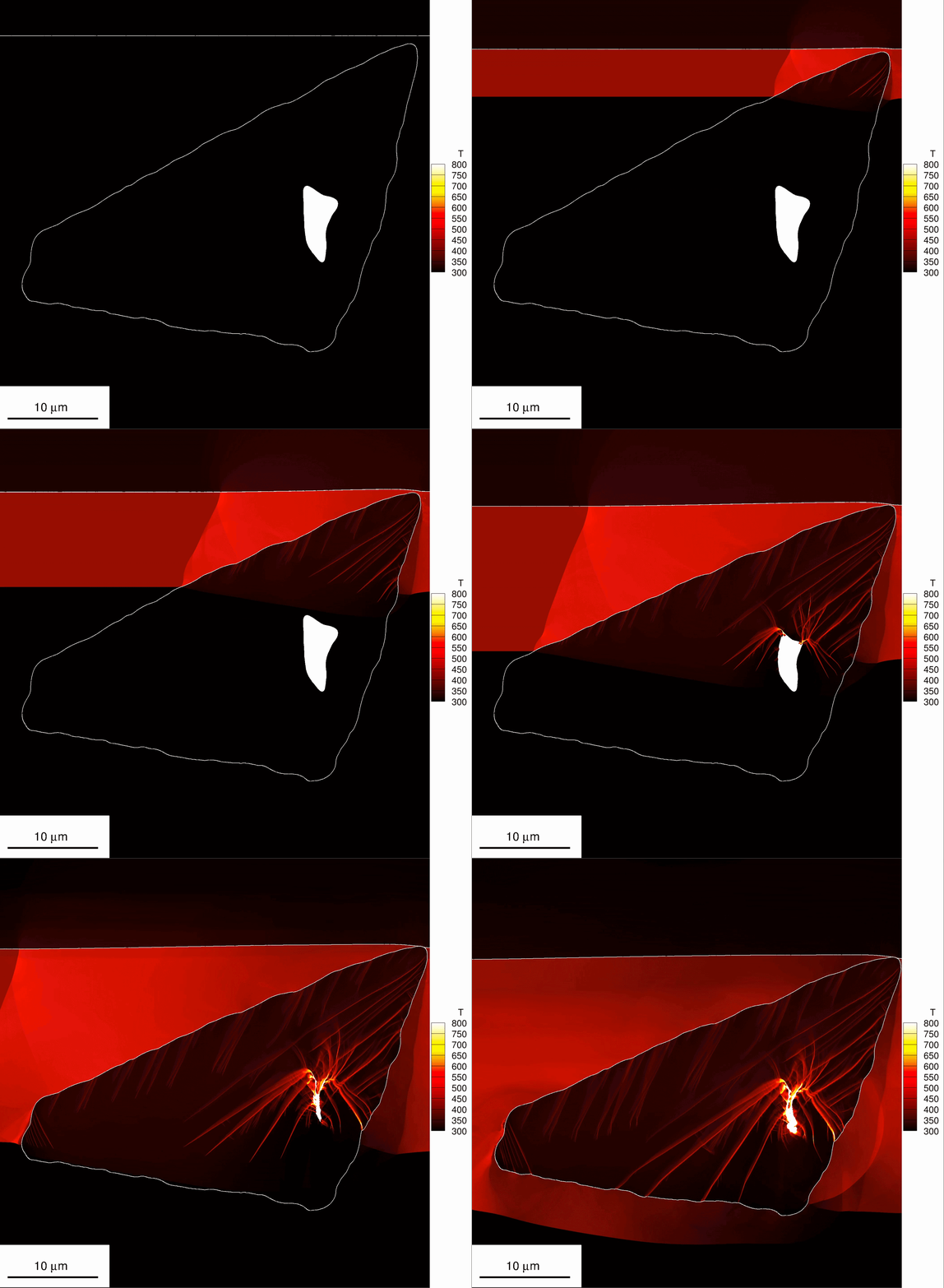
My work connects image-derived microstructures of energetic composites, sharp-interface mesoscale simulation, and physics-aware ML so that surrogate models can be evaluated on quantities that matter physically: pore collapse, hotspot formation, shear localization, shock propagation, damage evolution, and the resulting continuum response under extreme loading.
The site highlights four threads: SCIMITAR3D solver development, production HPC campaigns on DoD systems, the HEDS microstructure-to-sensitivity framework, and physics-aware ML benchmarks for PARC / D-PARC neural surrogates.
Featured Projects
SCIMITAR3D solver development
Sharp-interface, multi-material reactive-flow framework. WENO + ghost-fluid integration cuts the grid-refinement overhead for equivalent accuracy by roughly 2.5–3×.
Production HPC campaigns
Microstructure-resolved mesoscale simulations on DoD HPC systems — 140M cells, 7,000 cores, ~2.8M CPU-hours per campaign.
HEDS framework
Diffusion / U-Net / CycleGAN microstructure generation paired with high-fidelity simulation to study damage–sensitivity behavior.
Physics-aware ML benchmarks
DNS ground truth and physics-consistent evaluation for PARC and D-PARC neural surrogates of shocked energetic-material response.
Selected Publications
- Fang, I., Roy, S., Nguyen, P.C.H., Baek, S.S., Udaykumar, H.S. - Heterogeneous Energetic Material Damage Simulator (HEDS): A Deep Learning Approach to Simulate Damage-Sensitivity Linkages, APL Machine Learning 3(2), 2025.
- Roy, S., Johnson, B.P., Zhou, X., Nguyen, Y.T.H., Dlott, D.D., & Udaykumar, H.S. - Hot Spot Ignition and Growth from Tandem Micro-Scale Simulations and Experiments on Plastic-Bonded Explosives, Journal of Applied Physics 131(20), 2022.
- Roy, S., Gopalapillai, R. - An Analytical Model for Asymmetric Mach Reflection Configuration in Steady Flows, Journal of Fluid Mechanics 863, 242-268, 2019.
Technical Capabilities
Numerical methods
High-order finite-volume methods, WENO-type reconstruction, level-set and ghost-fluid methods, operator splitting, and reactive multi-material coupling.
Scientific computing
MPI-based production simulation, domain decomposition, Slurm/PBS workflows, parallel I/O, validation against experiments, and reproducible post-processing.
Physics-aware ML
Simulation datasets, model evaluation protocols, microstructure generation interfaces, neural-operator/PARC-family benchmarking, and conservation-aware interpretation.