SCIMITAR3D Solver Development
Problem
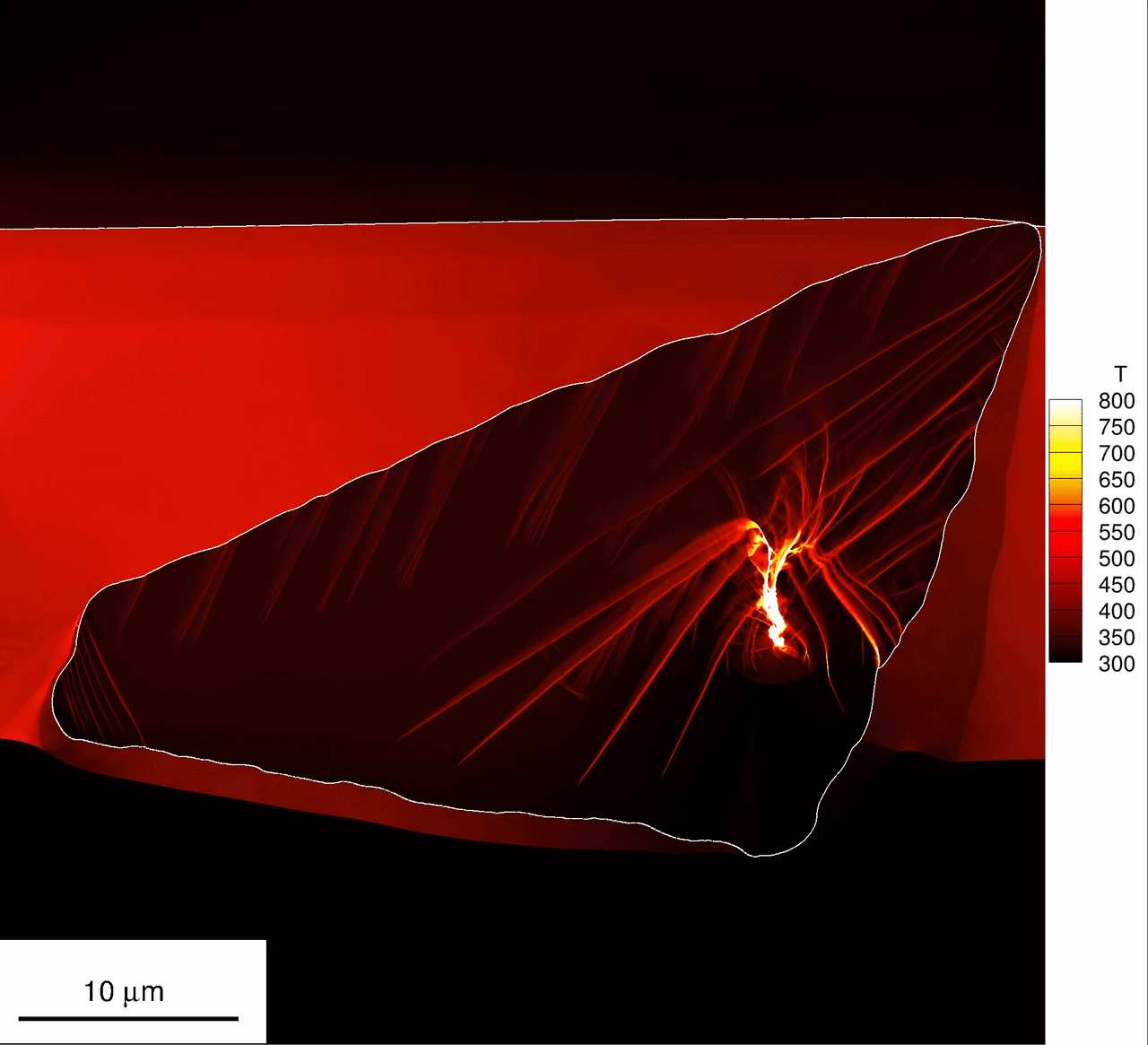
Shock-to-detonation transition in heterogeneous energetic materials depends on strongly localized physics: crystal-binder interfaces, void collapse, hotspot growth, and reactive wave coupling. Coarse or overly diffusive simulation methods can miss the sub-grain features that determine whether a local event grows or decays.
Technical Approach
I extended SCIMITAR3D into a multi-component, sharp-interface framework for high-speed reactive multi-material dynamics. Core contributions: integration of full fifth-order WENO reconstruction and Riemann-based ghost-fluid coupling for multi-material interface tracking, plus mesoscale solver workflows for energetic-material geometries derived from imaged microstructures. Postdoc-era extensions include novel interfacial treatments for materials transitioning from solid-with-strength to hydrodynamic flow during chemical decomposition, and augmentation of JWL and Mie–Grüneisen equations of state to span the full tensile-to-high-compression pressure range needed for macroscale shock-to-detonation runs.
Scale and Constraints
The solver had to support reactive compressible flow, sharp material interfaces, stiff thermo-chemical kinetics, and production runs on university and DoD HPC systems. A primary engineering constraint: reduce numerical diffusion without driving grid requirements out of reach for microstructure-resolved campaigns.
Tech stack: Fortran 90 / C++ / Python · MPI with domain decomposition · Slurm / PBS · parallel I/O · DoD HPC clusters.
Validation
Simulation predictions were validated against experimental observations from collaborators at UIUC (Dlott group) and Los Alamos National Laboratory. Validation centered on physically meaningful observables: hotspot formation, shock response, burn-front velocity, and sensitivity trends under controlled flyer-impact loading.
Outcome
- Engineering win: the WENO + Riemann-based ghost-fluid integration eliminates the roughly 2.5–3× grid-refinement overhead otherwise required for equivalent accuracy at lower order — a direct cost reduction for every downstream campaign.
- Capability: SCIMITAR3D is now the simulation backbone for multiple PhD and postdoctoral threads, including the HEDS dataset pipeline and current physics-aware deep learning benchmarks.
- Publications: two Shock Waves journal papers accepted/in production (2025) on high-order multi-material methods and on shock initiation of an HMX crystal–binder system.
Links
- Okafor, Seshadri, Roy, Udaykumar — High-Order Eulerian Sharp Interface Numerical Techniques…, Shock Waves, 2025.
- Roy, Seshadri, Okafor, Johnson, Udaykumar — High-Fidelity Simulations of Shock Initiation of an Energetic Crystal–Binder System Due to Flyer Impact, Shock Waves, 2025.
- Talk: SCIMITAR3D-V2.0, APS SCCM 2025.