HEDS Framework
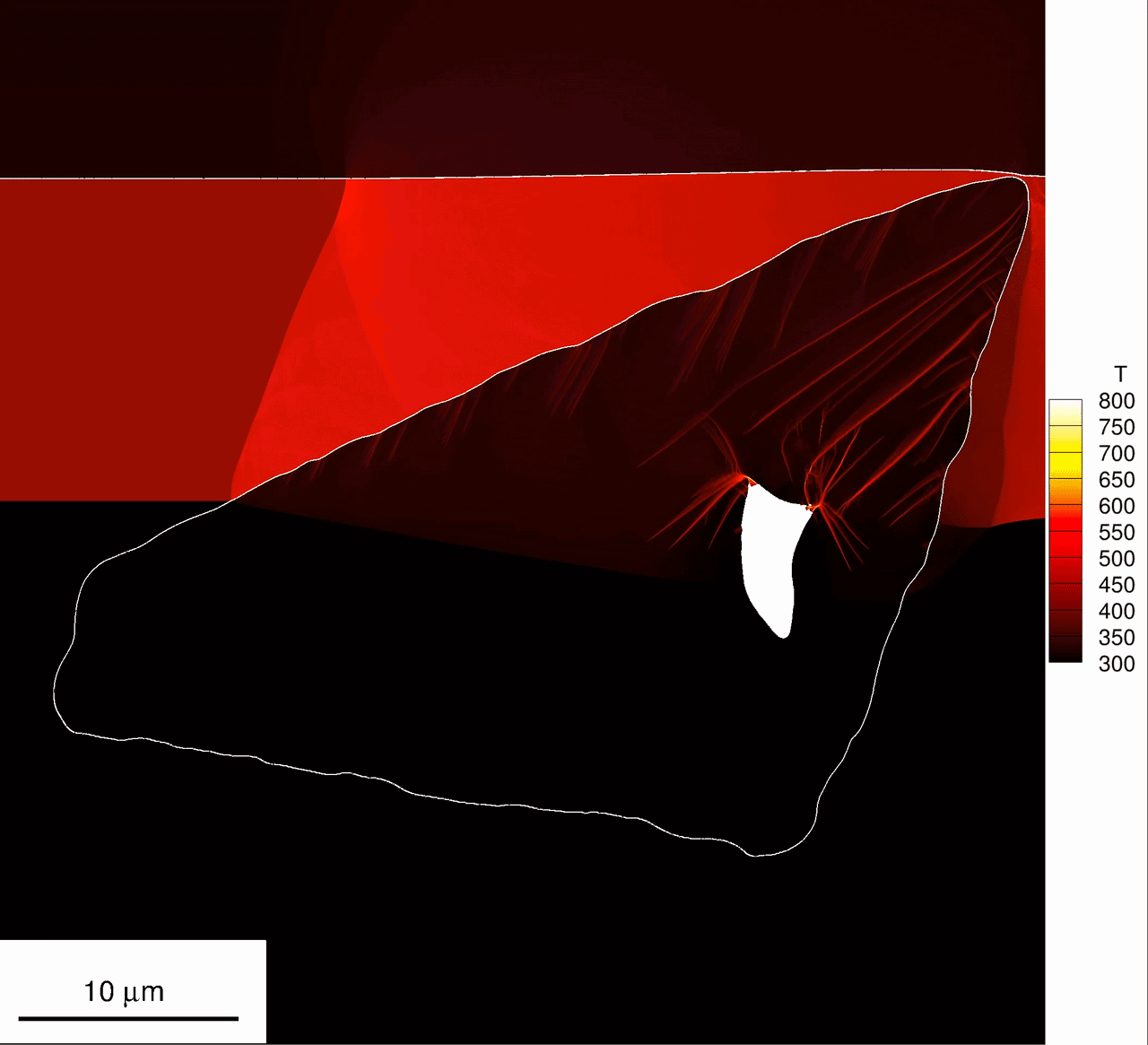
Problem
Energetic-material sensitivity is controlled by how microstructure concentrates energy under shock loading: where pores collapse, how damage accumulates, whether a hotspot grows or decays. The practical question for a hiring lens: given a synthetic or imaged microstructure, can we predict whether it is more or less likely to ignite under shock — with physics constraints baked in rather than learned by accident?
Technical Approach
HEDS pairs deep generative microstructure modeling with computational mechanics. ML-generated microstructures (diffusion models, U-Net, CycleGAN) feed into high-fidelity simulations, and the simulation response is used to evaluate and interpret the learned representations. My contribution centered on the simulation and physics-validation side: curating high-fidelity simulation outputs, defining physically grounded evaluation criteria, and analyzing damage–sensitivity behavior on the generated structures. ML architecture and training were led by collaborators (co-developed with 2 PhD students).
Scale and Constraints
The pipeline needed simulation-ready microstructures, physically grounded response quantities (pressure/temperature field evolution, hotspot statistics), and a comparison workflow for synthetic vs. imaged microstructures that respected conservation and damage-mechanics constraints.
Validation
Validation asked whether generated microstructures preserved physically meaningful trends in damage, hotspot formation, and shock response — not just visual realism. SCIMITAR3D simulation outputs served as ground-truth anchors.
Outcome
- Publication: Heterogeneous Energetic Material Damage Simulator (HEDS) in APL Machine Learning 3(2), 2025.
- Topical context: HEDS sits in a broader thread of physics-aware ML for energetic materials at Iowa and partner institutions, alongside parallel work on the PARC and D-PARC architectures (separate UVA collaboration).
Links
- Fang, Roy, Nguyen, Baek, Udaykumar — Heterogeneous Energetic Material Damage Simulator (HEDS), APL Machine Learning 3(2), 2025.