Production HPC Campaigns: Mesoscale Shock Initiation
Problem
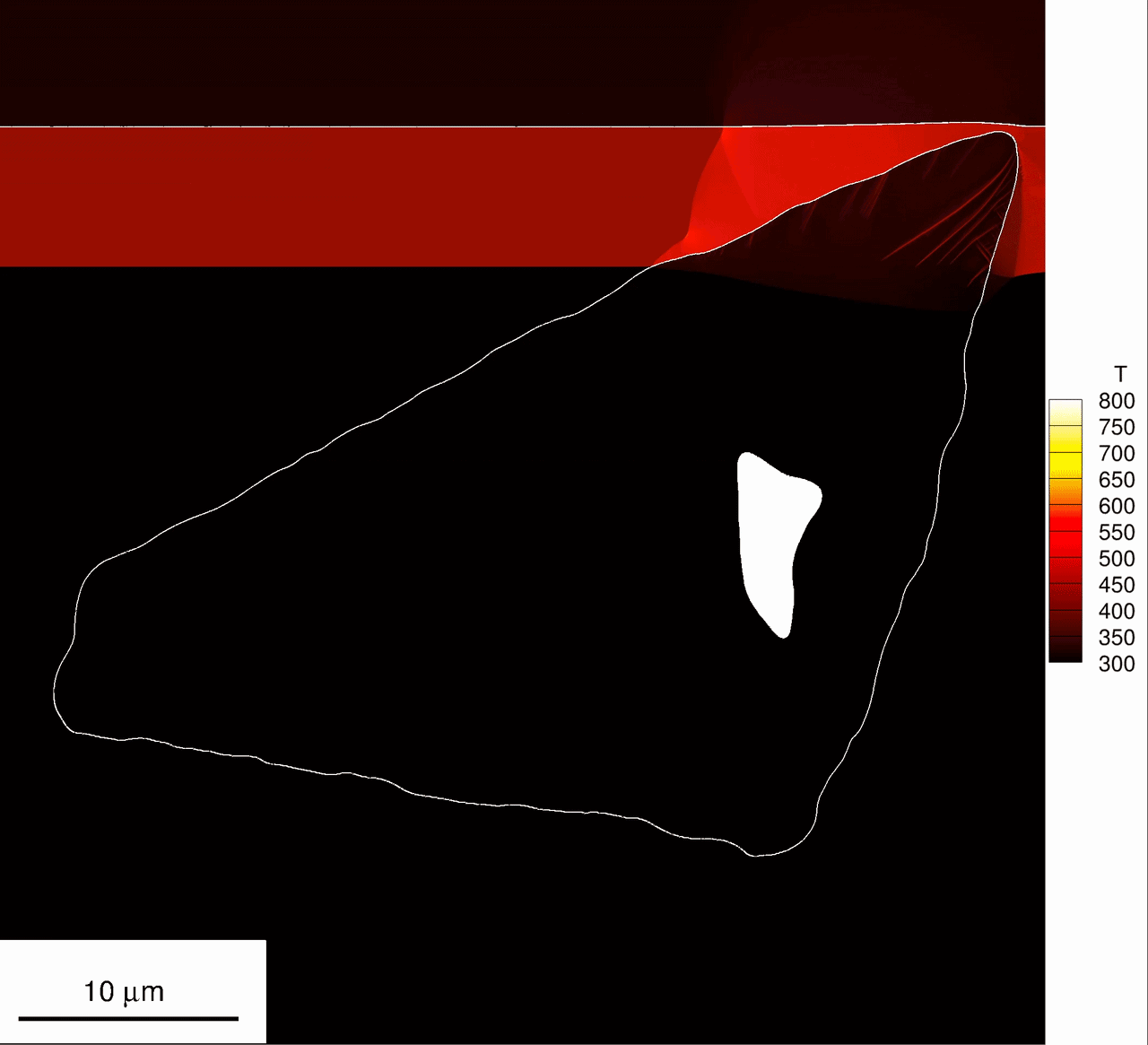
Energetic-material initiation is governed by small, rare, localized events: pore collapse, shear localization, and hotspot growth at sub-grain scale. To compare simulations meaningfully with experiments and with learned surrogates, the computation must resolve those features rather than average them away.
Technical Approach
I designed and managed production-scale reactive multi-material simulation campaigns using SCIMITAR3D on DoD HPC systems. The campaigns resolved crystal–binder interfaces, voids, shock interaction, and hotspot evolution in microstructure-aware HMX-based PBX configurations — with constitutive models and resolution criteria selected for head-to-head comparison against experimental observations.
Scale and Constraints
- Grid: 140M cells
- Concurrency: 7,000 CPU cores
- Compute: ~2.8M CPU-hours per representative campaign
- Why this scale: hotspot statistics approached a grid-converged threshold only when sub-micron microstructural features were explicitly resolved — under that, the answers move with grid, not with physics.
Validation
Campaigns were tied to experiments and collaborator observations from UIUC (Dlott group) and Los Alamos National Laboratory, with simulation design driven by head-to-head comparison, resolution criteria, and physically interpretable observables (burn-front velocity, energy localization, ignition thresholds).
Outcome
- Publications: Hot Spot Ignition and Growth…, Journal of Applied Physics 131(20), 2022; High-Fidelity Simulations of Shock Initiation…, Shock Waves (in production, 2025).
- Datasets: ground-truth DNS databases now reused for physics-aware ML benchmarking (PARC / D-PARC).
- Programs: simulation contributions to AFOSR-MURI Microstructurally-Aware Continuum Models for Energetic Materials (7-institution consortium, 2019–2024) and ONR-MURI Non-Equilibrium Energy Propagation/Transfer in Condensed-Phase Exothermic Reactions (2025–present).